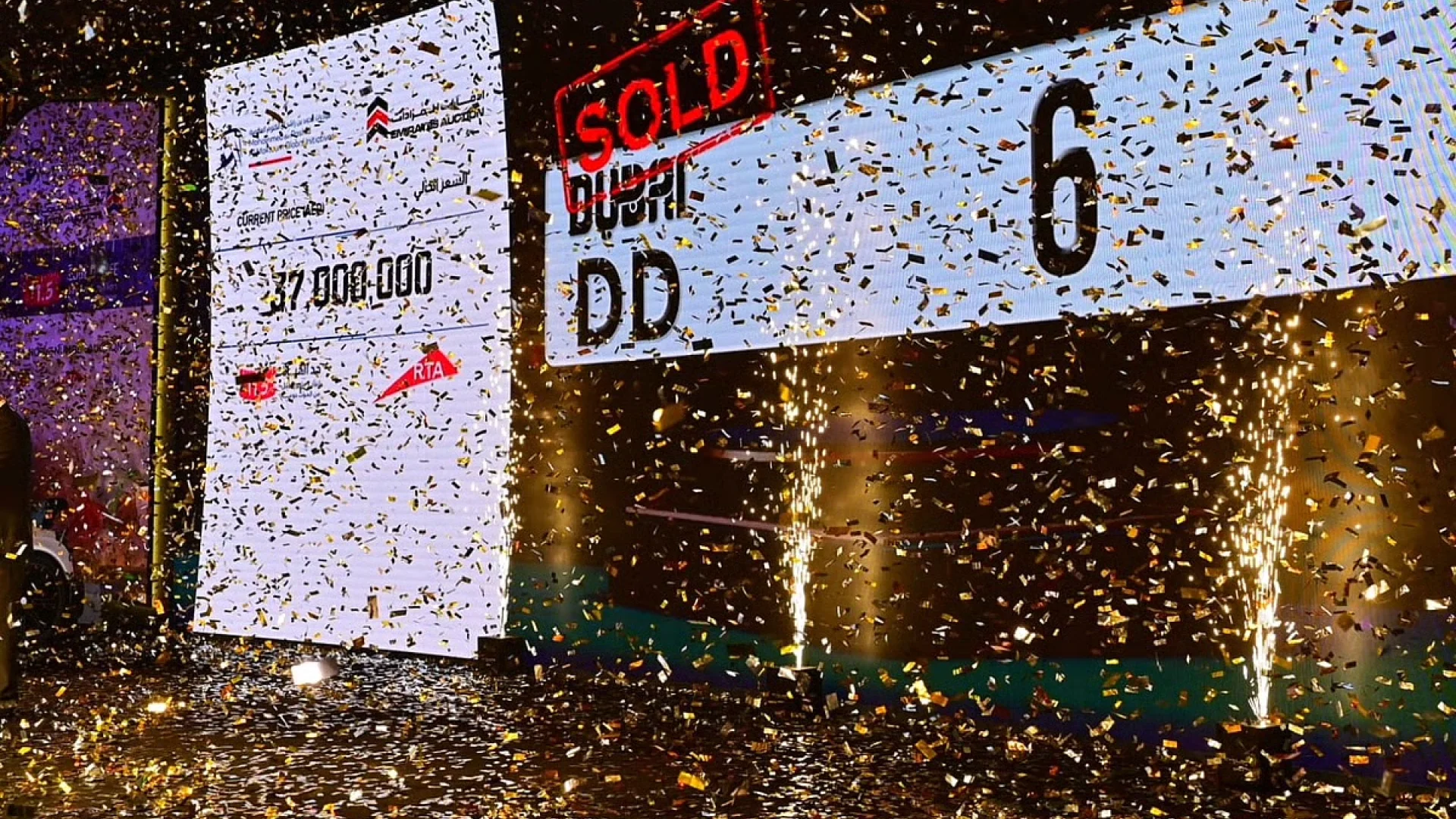
In Dubai, a number can carry the weight of a title—and the price tag of a penthouse. At the “Most Noble Number” auction, the license plate DD 6 was sold for Dh37 million, one of the event’s standout results and a fresh headline in the emirate’s ongoing love affair with rarity. The bidding was theater: quick nods, clipped whispers, and a hammer that turned symbolism into an asset. For investors, the sale is a sharp indicator of liquidity at the very top and the brand power that continues to pull wealth—and spending—into Dubai.
The room doesn’t roar. It hums.
A soft, expensive hum—tailored jackets brushing chairs, watches catching the light, phones held low like secrets. Up front, the auctioneer’s voice lands with the calm certainty of someone who knows exactly what people came to do here: compete, quietly, for something that isn’t supposed to matter… and somehow matters more than it should.
“Thirty-seven million.”
A pause. A final look from one bidder to another. A tiny tilt of the head—yes. The hammer falls. And just like that, Dubai sells a single digit to the highest conviction in the room.
The license plate is DD 6. Two letters. One number. In most cities it would be admin—paperwork, a fee, a forgettable rectangle fixed to metal. In Dubai, it’s a social signal that travels on wheels. It’s the kind of detail valets notice first, the kind of detail that turns a driveway into a stage.
At Dubai’s “Most Noble Number” auction, DD 6 sold for Dh37 million, instantly becoming one of those numbers people repeat the way they repeat skyscraper heights and supercar horsepower. Not because the plate changes how a car drives, but because it changes how a person is seen.
There’s a choreography to these auctions that’s almost intimate. Nobody needs to wave wildly. A finger lifts. A chin dips. A glance is exchanged across two rows like a dare.
“Again?” someone murmurs—half question, half provocation.
“Again,” comes the answer, as if it’s the easiest thing in the world.
The numbers climb in leaps. The air tightens. And what looks, from the outside, like extravagance for extravagance’s sake is actually something more specific: the pursuit of rarity. Short plates are scarce. Clean digits are scarce. The simplest combinations are the hardest to get—and in a city built on the aesthetics of achievement, simplicity is the most exclusive luxury of all.
Dubai has trained the world to read symbols fast. A skyline is a message. A beachfront address is a message. A two-digit—or one-digit—plate is a message, too. The shorter the number, the louder it speaks, and the less it needs translation.
DD 6 doesn’t just sit on a bumper. It announces itself in traffic. It slips through hotel entrances like a VIP wristband. It turns a routine stop at a café into a moment of silent acknowledgment: That’s not a regular plate.
Events like “Most Noble Number” are never only about the winner. They’re about the ecosystem around the winner: the spectacle, the social proof, and—often—the philanthropic dimension that gives the whole evening a second narrative. Dubai has become adept at staging luxury in a way that also signals contribution. Status and giving are frequently braided together, so a record sale doesn’t land as a guilty indulgence; it lands as a headline with purpose.
That dual framing matters. It keeps the event in the public imagination as more than a rich-person game. It makes it part of the city’s broader brand: ambitious, glossy, and unusually effective at turning attention into action.
Picture the moment after the applause fades—if there is applause at all. The new owner leaves, composed. Somewhere later, in a bright workshop bay, a technician holds the plate for a second longer than necessary. Not because it’s fragile, but because it’s iconic.
Screws turn. The plate clicks into place. The car rolls out—maybe a supercar in a color that looks like liquid, maybe a limousine so quiet it feels sealed from the world. Then the city does what it always does: it watches. A valet takes a photo when he thinks no one’s looking. A passerby nudges a friend. The legend begins, again, at street level.
It measures far more than a plate.
It measures confidence—because trophy spending usually expands when people feel secure about tomorrow. It measures liquidity—because you don’t park Dh37 million in symbolism unless your fundamentals are already handled. And it measures Dubai’s continuing ability to attract and entertain global wealth, not just with policies and infrastructure, but with narratives: events that turn private power into public moments.
In other words, the sale is a small object carrying a big dataset about the city’s current mood at the top end.
For real estate investors, a record license-plate sale is not trivia—it’s a high-frequency signal from the uppermost slice of the demand curve. It suggests that the pool of high-net-worth individuals in Dubai (and those shopping Dubai from abroad) remains deep, liquid, and willing to pay aggressively for scarcity.
1) Luxury liquidity supports prime residential absorption
Buyers who treat a plate like a trophy often treat property the same way: as an extension of identity. That mindset tends to support:
2) Brand Dubai amplifies international buyer flow
Headlines like Dh37 million for DD 6 travel globally. They reinforce Dubai’s positioning as a safe, highly serviced lifestyle hub—an effect that can widen the funnel of prospective buyers and renters, particularly among internationally mobile entrepreneurs and executives.
3) Event-driven networks lubricate deal-making
High-profile auctions function as social infrastructure. They gather business owners, family offices, and decision-makers in one room—exactly the kind of environment where off-market property conversations start and where premium projects find their first serious interest.
4) Practical takeaways for investors
Bottom line: DD 6 selling for Dh37 million is a loud, clean data point: Dubai’s luxury ecosystem remains confident and cash-rich. That confidence tends to spill into ultra-prime real estate—where scarcity, branding, and visibility command a premium.